
EV insights
Insights into Queensland’s Electric Vehicle (EV) numbers, market shares, charging arrangements, research and more.
This page is presented in two sections: EV data and EV research.
EV data
We maintain the only all-compassing EV data set for Queensland, i.e. including Battery EVs (BEVs) and Plug-in Hybrid EVs (PHEVs), from motorcycles to trucks. We share key data below to inform anyone interested in the Queensland EV market.
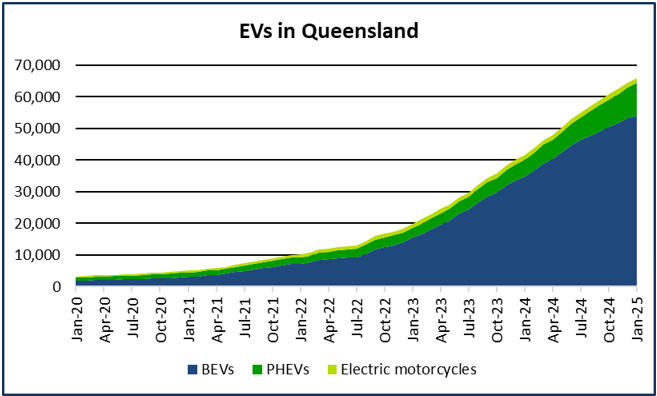
At the end of June 2026, Queensland had registrations for:
- 95,154 BEVs, including 646 light commercial vehicles, 193 electric buses and 51 electric trucks,
- 31,301 PHEVs, and
- 2,234 electric motorcycles,
creating a total of:
- 126,455 EVs excluding motorcycles, and
- 128,689 including motorcycles.
Source: Analysis of data of battery EVs and plug-in hybrid EVs provided monthly to us by the Queensland Department of Transport and Main Roads under a Memorandum of Understanding.
EV market shares
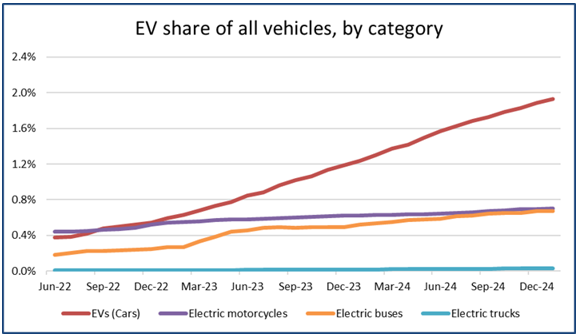
At the end of June 2026, EVs reached market shares in Queensland of:
- 3.67% of cars,
- 0.90% of motorcycles,
- 0.79% of buses, and
- 0.04% of trucks.
Source: Analysis of data of battery EVs, plug-in hybrid EVs and all vehicles provided monthly to Energex and Ergon Energy Network by the Queensland Department of Transport and Main Roads under a Memorandum of Understanding.
Of all EVs (excluding motorcycles) in Queensland, 88.3% are registered in South East Queensland, and 11.7% in regional Queensland. Approximately 69% of Queenslanders live in South East Queensland.
This data is updated after every quarter, i.e. in January, April, July and October.
Except as permitted by the copyright law, you may not reproduce or communicate any of the content on this web page, including files downloadable from this web page, without the permission of the copyright owner.
EV research
EV SmartCharge Queensland Program
Just as we evolved our network to support an abundance of air conditioning and rooftop solar, we will need to cater for the electrification of transport.
Balancing demand and supply has always been the key to delivering secure, affordable, sustainable and safe energy solutions.
That’s why, back in late 2022, we completed an EV research program focussed on residential charging, to get on the front foot. We gathered data to help us understand the needs of our customers and the potential impact of their EV charging behaviours on the electricity network.
The results of the program, which analysed driving and charging profiles of Queensland EV owners, are still helping us make decisions that will benefit EV customers and the electricity network that supports them.
Read the results in our EV SmartCharge Queensland Insights Report (PDF 19.4 mb) and view our short video below.
The report has informed the development of new tariffs, dynamic customer connections, demand management opportunities and more. As an industry we are facing a new wave of opportunities and challenges from EVs, so it is critical to have the data to develop real solutions that are good for you and good for the network.
Our report provides insights into aspects such as:
- The influence of electricity tariffs on EV charging behaviour
- Different charging profiles based on solar, non-solar and or battery energy storage system ownership
- Network implications of EV charging
- Weekday and weekend charging
- Charging behaviour at home versus other locations
- Length of charge – top-up versus long charge
- Distances travelled.
Summary of key learnings
Skip to descriptionWe did find that the average commute for customers used about between 6-10 kilowatt hours per day. So that’s a relatively easy opportunity for charging, whether it’s a slow charge off a simple plug or whether you want to have a special fast charger in your home.
So plenty of opportunity for customers to charge their EVs quite simply on a daily basis.
We found that far more people charged away from home than other studies would have actually suggested, so this is where a Queensland perspective has been quite interesting.
Other studies have shown that on average about 80% of charging happens at home. We found it was nearer more the mid-60s, which for us gives us an understanding that people are more happy to travel longer distances and charge away from home.
The other thing that we did find was that compared to ICE vehicles – internal combustion engine or traditional engine vehicles – people were travelling about 20% further in their EVs than a normal petrol/diesel car.
Certainly, you want to look at the sort of trips that you do, but with the vehicles these days, most trips are not a problem at all with fast-charging – 300 or 400km trips are no problem at all. Now with the Tesla, with the much longer range, we basically never have range anxiety.
The penetration of solar in Queensland, even compared to other states in Australia, is high and so that’s going to provide a difference that we wanted to understand – how people use their renewables and solar generation at home to impact their EV charging behaviour.
Also the fact that we have a highly-urbanised society as well as our regional and rural customers, and we wanted to understand necessarily how EV charging would be impacted by where people actually live.
I think the key thing is you know people are looking at you know what sort of charging behaviours are financially beneficial in terms of charging when the rates are low.
As we have now understood a lot more about how customers like to charge their EVs and indeed what the opportunities around tariffs and solar generation mean for customers, we can work into that options that can provide customers future-proof solutions for charging that will be suitable for them and for the network for many, many years to come.
Summary of key learnings
Watch this video to find out what we learnt about EV owner charging behaviours in Queensland.
If you have any questions about this report, please contact us at evsmartcharge@energyq.com.au
Queensland Household Energy Survey
This unique survey has over 4,000 participants each year, of which an increasing proportion have an EV. We ask those EV owners about:
- Their home charging arrangement
- Their charging behaviours and influences
- Where their EV is parked during the day
- Their awareness of Vehicle to Grid, and more.
Here are the results from the EV questions. From that same page, you can access other insights from the survey, about solar PV, battery storage and more.