

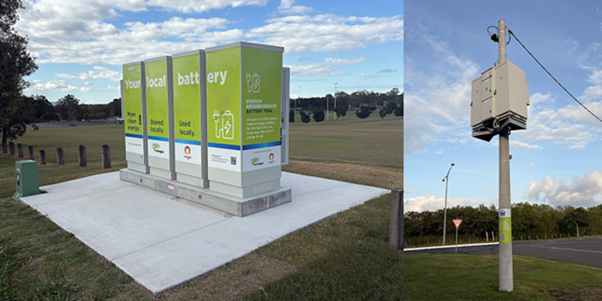
Some examples of community batteries
Community battery engagement
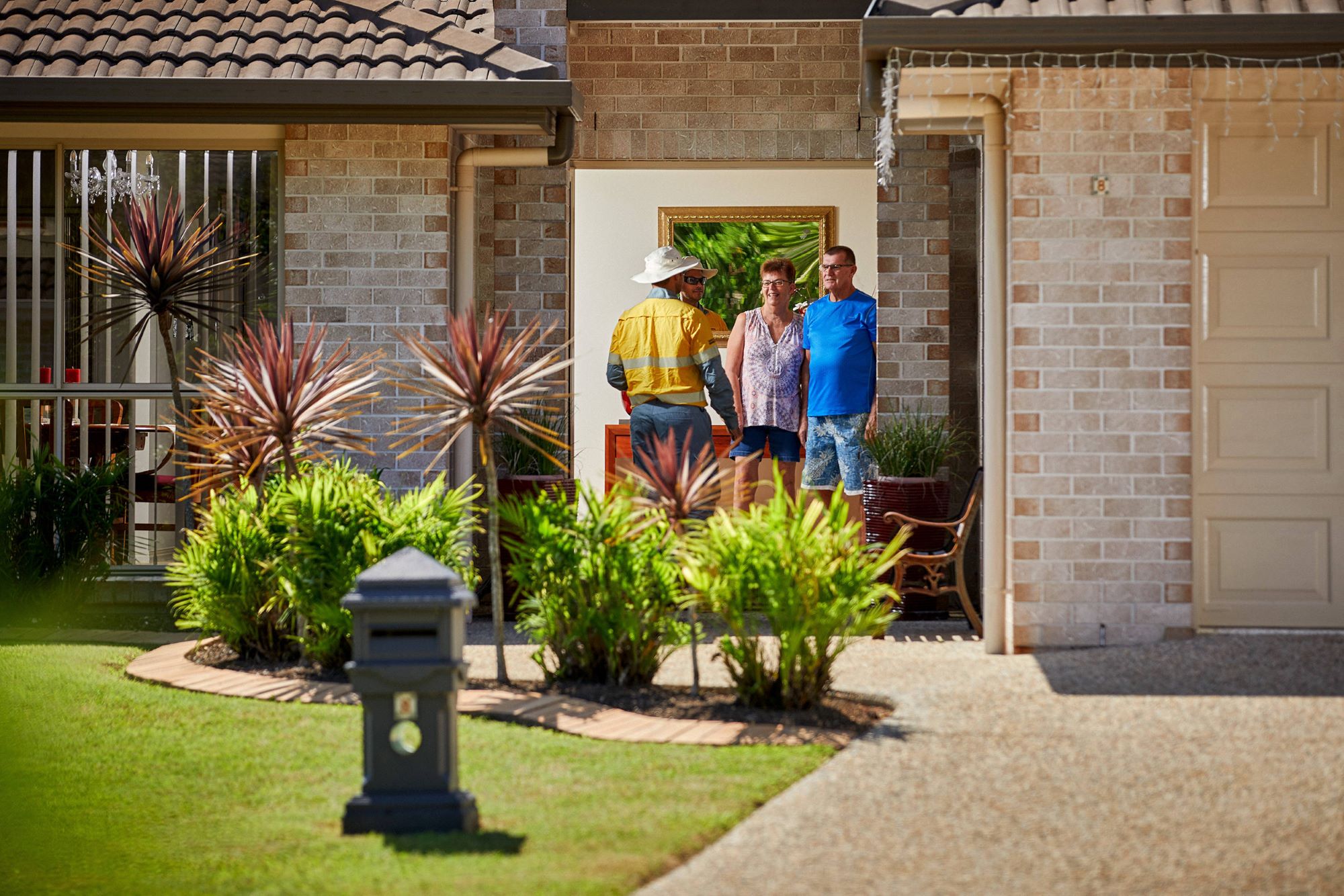
We are engaging locally as we connect community batteries to the Low Voltage electricity distribution network across Queensland.
These batteries are helping make the most of the community’s rooftop solar. They allow more solar energy to be exported to the grid when the sun is shining. The energy is then stored for use locally when electricity demand is high.
Building on the lessons learnt and success of the Ipswich Neighbourhood Battery Trial, we are currently rolling out these small-scale batteries to create more battery neighbourhoods, and to support other locations across the state.
Where batteries are being installed
We are currently installing the last of the batteries funded through the Australian Government Department of Climate Change, Energy, the Environment and Water’s Community Batteries for Household Solar program. These are located in Cairns North and throughout South East Queensland.
With support from the Australian Renewable Energy Agency (ARENA), we are now building on these with up to 69 more community batteries to be installed as part of ARENA’s Community Batteries Funding Round 1.
These will create new battery neighbourhoods in:
- Bundaberg and Hervey Bay
- Kingston, North Maclean and Jimboomba (Brisbane South)
- Bribie Island, Morayfield and Scarborough (Brisbane North).
In addition, we are investing in community batteries in Energex's Caloundra, and Ergon Energy’s North Townsville network zones.
Community battery locations map
Check out the map to see the battery locations as the new sites are added.
Sharing the benefits with communities
Community batteries help:
- Support more rooftop solar
- Put downward pressure on electricity costs
- Reduce pressure on the electricity network
- Improve security and reliability of supply.
As part of government-funded programs, we are also sharing benefits locally through our Community Fund.
The Community Fund supports projects that help local communities, including:
- Disaster preparedness and recovery
- Community resilience projects
- Renewable energy and electrification initiatives
- Energy literacy education.
When applying, let us know you heard about the Community Fund through a community battery promotion.
Register for Community Fund updates
Frequently asked questions
Network battery types
To help support more rooftop solar and Queensland’s energy transition, we have several battery programs underway as part of our Local Network Battery Plan:
- Community Network batteries – since the success of our first six large utility-scale 4MW/8MWh batteries connected into the High Voltage electricity distribution in Bundaberg, Hervey Bay, Toowoomba, Townsville and Yeppoon, we have moved onto stage two with 12 more batteries connected, and now stage three with another 12 batteries being connected, using different battery suppliers.
- Ipswich Neighborhood Battery Trial – Energex has connected 35 community batteries, both on power poles and at ground-level, into the Low Voltage electricity network in Raceview, Goodna, Flinders View, Silkstone, Bellbird Park, and Redbank Plains. The $10 million trial is an Energex-Origin collaboration; as the electricity retail partner. To find out more visit Community batteries.
- Community batteries – Following the success of the Ipswich trial, we have connected more community batteries into the local electricity networks across a number of different Queensland communities, and are continuing to install community batteries across ten more targeted battery neighbourhoods.
The first were funded through the Australian Government’s Community Batteries for Household Solar - Delivery of Election Commitments Stream 1 program, with the larger roll out supported by the Australian Renewable Energy Agency’s (ARENA) Community Batteries Funding Round 1 under ARENA’s Advancing Renewables Program (with our investment). - Flow batteries – we have investigated the benefits of flow batteries, with a Vanadium Redox Flow battery trial underway at Energex’s Berrinba Depot. By testing flow batteries now, we will be in a better position to advance future battery deployments, depending on the needs and the sites.
Why we're investing in batteries
Distribution network-connected batteries enable more rooftop solar locally and support the network during high peak demand days, with more homes and businesses in the community benefiting, while reducing the pressure on the electricity network.
Queensland is already leading the way in the take up of solar energy – with close to 7GW of rooftop solar – the highest uptake of any Australian state. We are now working to ensure Queensland’s electricity networks can support the additional solar energy uptake anticipated in the future – potentially an increase of more than 4GW by 2030. Source Queensland Energy Roadmap.
Your local battery will allow the solar energy made locally, during the day, to be stored locally, and used locally during the evening when the demand for electricity is at its highest.
Together the batteries will ensure the stability of the electricity network, by addressing the challenges of reverse and negative power flows locally, as well helping to manage minimum network demand during the day when rooftop solar generation is high and grid demand is low.
This is just one of the ways we are enabling the energy transition and, ultimately, by avoiding major infrastructure investment, helping to keep electricity prices down.
Rooftop solar is changing the way the network is being used. Gone are the days of a single-direction flow of electricity from powerlines into homes and businesses.
Now, it’s two-way, with more than 900,000 solar energy systems state-wide feeding energy into the grid during the day, and then a rapid return to peak demand in the evening.
Batteries are an essential tool to help manage this change, addressing the challenges of reverse and negative power flows locally.
They also address changing demands at the system level, by allowing stored energy to be released during evening peaks, reducing reliance on peaking generators, easing network stress and improving overall market efficiency.
Yes, one of the alternatives to connecting batteries into the Low Voltage network where it is under strain is to invest in more traditional electricity distribution network solutions, like placing extra transformers across Queensland’s electricity networks.
Batteries differ from transformers in that they can provide a wider range of benefits for different stakeholders, from customers, to networks to retailers as compared to more traditional network solutions.
Both can be a solution for managing the network, and supporting future technologies and investments in batteries and transformers will be determined on a case-by-case basis.
While our battery investment will help us address the solar-related challenges on the distribution network, industry modelling shows significantly more storage will be required to maintain security of supply as we move to even higher levels of rooftop and large scale solar.
It will require storage throughout the supply chain, as well as commercial proponents investing in large-scale batteries, and our customers putting in batteries ‘behind the meter’. And even then, energy storage solutions will only be one of the many different solutions needed to manage the grid going forward.
We’re also taking action in other ways, with changes to load control, tariff reform, and the introduction of dynamic connections. For new large solar installations, dynamic connections are allowing more renewable energy to be exported when the network capacity is available locally, with lower export limits only activated when needed to avoid overloading the network.
An emergency backstop mechanism has also been introduced that will allow us to shut off new solar exports if network stability is at risk.
Customer opportunities
We are operating the network batteries in the interest of our customers, and the wider community, to efficiently manage the local electricity supply. This helps keep prices down for all, but it will not change what you pay individually for electricity locally in comparison to anywhere else.
In some areas, there may be an opportunity, through electricity retailer partnerships, for members of the local community to test different product offers associated with the batteries, as an alternative to buying a ‘residential’ or ‘behind the meter’ battery. This could help you save money.
In Ipswich, where we’ve partnered up with Origin, they are giving local households and small businesses in the Ipswich City Council area the chance to ‘subscribe to use’ a proportion of a battery. During the day, Origin stores the excess rooftop solar in the community in the batteries, and then allows customers to draw it back for ‘free’ when the sun goes down.
It is like having a battery without the hassle of installation, maintenance or high upfront costs. And you don’t need to own solar panels or be an Origin customer to join this trial. To find out more visit Origin and Energex Neighbourhood Community Battery Trial.
Yes, to further support the local community, the batteries enabled us to increase the Ergon-Energex Community Fund. These extra grants of up to $10,000 are available to the communities hosting the batteries, with a particular focus on funding disaster preparedness and recovery, community resilience generally, or sustainability projects that help the community benefit from the energy transition.
If you know of any groups making a positive impact, please encourage them to take a look at the Funds webpage, and to register for an update when the next round of funding opens.
And when applying, tick ‘Community battery promotion’ for the Marketing Information question at the very end of the application.
Operating the batteries
The batteries are connected into the local electricity network. They will be used to soak up the excess solar energy generated during the day from local rooftop solar systems.
Then, when the sun goes down, the stored energy will be released back into the network for use during the evening peak when demand is high.
Through an electricity retailer partnership, the excess capacity in the batteries will be traded on the electricity market in order to maximise the benefits of the batteries.
We are also working with retailer/s and the community to develop appropriate models to maximise the benefits of the batteries.
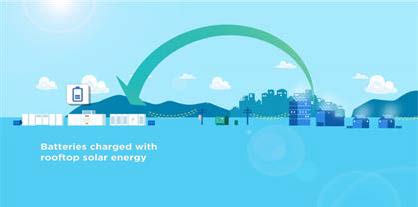
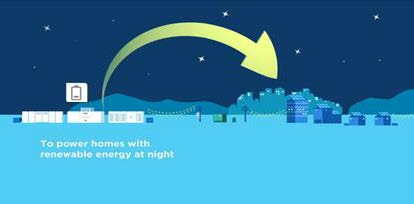
The intention is that the batteries will store solar energy during the day for use locally in the evening when the sun goes down and demand is high. And this solar energy is growing.
However, we cannot guarantee that it will always be 100% renewable energy. When your excess roof top solar energy is exported to the grid it becomes one with all the ‘electrons’ flowing through the powerlines. And at times, the sun conditions may be low, and the wholesale market or the needs of the network may influence how or when the battery is charged.
The battery technology
Batteries sizes are talked about in kW (kilowatts) and kWh (kilowatt hours). One way to visualise this is to think of water from a hose or in a bucket:
- kW (kilowatts) - the power available at any point in time is the ‘water’ that you can get with the ‘size of the hose’
- kWh (kilowatt hours) - the energy stored is the ‘size of the bucket’.
Large utility-scale community network batteries – each of these batteries, which are connected to the High Voltage network, are 4MW/8MWh, the same capacity as the electricity required to support an average home for more than a year via the network, or power an electric vehicle for more than 45,000kms.
Neighbourhood/community batteries – each battery module is either 30kW/60kWh or 40kW/80kWh. This means, if they are fully charged, they can supply enough power over about two hours during the evening peak, at the full discharge rate, for about 10-15 customers. That’s around 4kWh to 6kWh of energy per customer.
The latest ground-level community batteries being rollout can produce 90kW of power and store 180kWh of energy. This means they are able to support over 60 homes in the local area for two hours The battery stores enough energy to drive an electric vehicle 1,200 kilometres.
If you were to use a battery to power the electricity you would normally purchase from the grid during non-daylight hours, and use a solar system at all other times, you would need a battery with a capacity of at least 10kWh, costing between $1,000 to $2,000 per kWh.
This is based on the average Australian household using approximately 16kWh of electricity per day. Assuming the household is out at work/school ‘9 to 5’ – that would mean about 30% of usage (5kWh) would be during the day and 70% at night (11kWh).
It is important to understand the terms – kW is a measurement of Power and kWh is a measurement of Energy. For example, you have a 60kW electric vehicle (EV) charging station and you use this to charge your EV for two hours – this means you have used 120kWh (i.e. 60kW x 2 hours).
On average running a refrigerator uses between 1-2kWh a day. The average power usage for one 2.5kW air conditioning unit running for eight hours could be 21-28kWh per day.
The batteries are Lithium-ion technology. We investigated the different batteries in the market, before moving forward with our current suppliers.
For the large utility-scale batteries, we have or are installing batteries from either Tesla, ABB Group, EVO Power and Penske. The program has stimulated local manufacturing with several suppliers with some or all of the assembly for the Penske and EVO Power products being performed in Queensland.
For the smaller batteries, we have worked with Pixii to develop their product specifications for use as our network-connected community battery solution. The PixiiPowerShaper battery is manufactured in Norway and assembled at Murarrie in Brisbane.
We are also advancing other technology with a Vanadium Redox Flow battery trial at Energex’s Berrinba Depot. Flow batteries are an alternative to Lithium-ion batteries, with different operational considerations to Lithium batteries and potentially some unique benefits.
The Lithium-ion batteries we are using are expected to have a minimum life span of 10 years, depending on how they are operated. They could have a life of up to 15 years.
And yes, they will be recycled at end-of-life. We have already engaged with an Australian recycling company.
We expect recycling services to evolve, potentially with economic opportunities for Queensland, as electric vehicle batteries drive demand for these services. This will see us review what is best practice, and our preferred recycler or recyclers, as our investment in battery technology scales up.
Europe has already introduced new rules requiring greener batteries with lower associated emissions, and recycled materials. This circular economy legislation, which covers the entire life cycle of a product, will drive innovation in battery recycling worldwide.
Battery sites & considerations
We are selecting sites where the local community has a high level of rooftop solar penetration – creating significant excess solar during the day, and reverse power flows. Some of the communities selected have been designated by the battery funding requirements.
The large utility-scale batteries are being located on our land, adjacent to existing infrastructure.
The pole mounted community batteries are being installed on new poles within the normal three-metre service alignment along the front of property boundaries.
The ground-level community batteries will either be in the current service alignment of our electricity infrastructure, or on another site negotiated with your local council. These sites need to be adjoining other electrical assets for ease of connection (substation / pad mounts), in a flood free zone, have vehicle access, and a clear area approximately five by five metres.
In selecting the locations, we have been mindful of the current land use, visual amenity, and the potential for any other local impacts, as we do for all of the equipment that supplies electricity to our customers. We are engaging the immediate neighbours as part of this roll out.
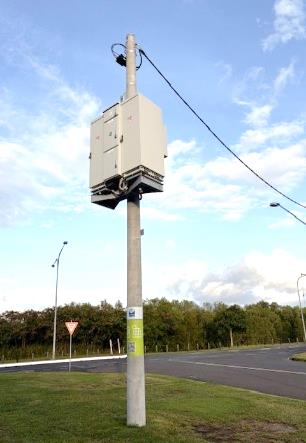
The pole top mounted community batteries are similar to others used by electricity distributors across Australia. The battery itself is two metres high and attached five metres up the electricity pole. They are being installed on new concrete poles.
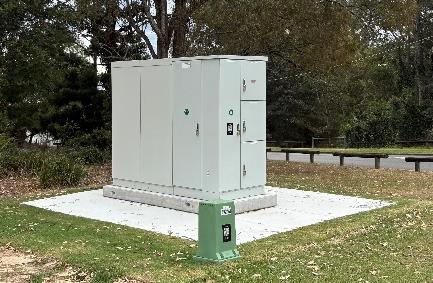
Each ground level battery is made up of four modules – three house the batteries and inverters and one houses the control and communication hardware. The modules sit on a concrete plinth, with a total land requirement of five-by-five metres.
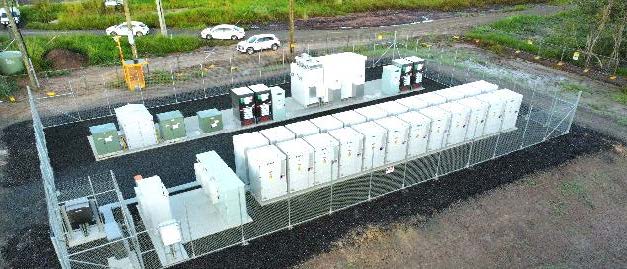
The large 4MW/8MWh utility-scale batteries have rows of modern, modular battery banks, with communications and electrical switching equipment. The sites are fenced, with landscaping, as required, to maintain the amenity of the area.
The battery are installed and maintained to the same high standard we would for any of our other electricity network assets. The operational practices for the batteries will also minimise the safety risks.
Like other chemical or energy infrastructure in the community, whether a petrol station or other electricity infrastructure, however, there are risks.
To address this risk the batteries will use the latest technology, be located within a clear area, and will be monitored remotely 24/7. The pole mounted batteries are being mounted the same way our transformers are mounted, on a new sturdy, fire-resistant concrete pole within the normal three-metre service alignment.
In the event an incident occurs, or smoke or fire is observed, stay well away, warn others, and call 000. Do not approach the system or attempt to put out the fire.
Queensland Fire Department (QFD) have protocols in place to respond in the unlikely event the batteries’ alarms are triggered, for example, by a vehicle impacting the power pole, or a battery malfunction. For each site, we will engage with local Fire crews, to ensure they are aware of the installations.
The Neighbourhood and community batteries have about the same energy storage capacity as an electric vehicle.
Read more from QFD about Lithium-ion battery fire safety for mobiles phones, electric scooters, electric vehicles, etc.
The batteries have fans enclosed in the units that will operate to keep the battery at the required temperature for safe operation. These fans are no louder than a household air conditioner and only operate intermittently.
In selecting the locations and designing the placement of the battery modules, we have also been mindful of the potential for noise to impact nearby neighbours, as we do for all of the equipment that supplies electricity to our customers.
We will monitor the noise levels. Care will be taken to ensure that noise impacts are minimised by ensuring that the sound is directed away from any nearby residents.
Electric and magnetic fields (EMFs) can be produced by anything with electric current flowing through it, including the powerlines, or your home’s wiring system or electrical appliances.
The powerlines or any of the equipment on the lines, like these batteries or more commonly pole-mounted transformers, however, will generally contribute little to the electrical fields that can be measured inside a house or nearby building. This is because the walls create a shield from the electrical field.
To reassure you further, all the equipment that we use and install onto our network must comply with strict industry standards. To learn more visit our Electric and magnetic fields web page.
Battery regulations
The regulations around network-connected batteries, under the National Electricity Rules (NER), are designed to ensure the safe and reliable integration of energy storage into the electricity grid. Under the Rules batteries are currently considered as ‘generation’.
Our progress with connecting energy storage into the distribution network will help inform the evolution of battery-related regulations. The batteries have been supported by the Australian Energy Regulator (AER), with a number of ring-fencing waivers allowing us to work with third parties to develop long-term sustainable models that maximise the benefit batteries can provide.
This means the batteries can support our regulated electricity distribution network, during peak demand periods, and the excess capacity can also be used by an electricity retailer for energy trading purposes (both energy arbitrage and Frequency Controlled Ancillary Services or ‘FCAS’; unregulated or market-facing activities). In Ipswich, this has allowed Origin to trial a community battery product offer, and across our high voltage, large utility-scale batteries, a range of retailers to trade the capacity of the battery.
The insights we gain from our battery program will be used to explore, if deemed of value, possible future changes to the rules.
The capital investment into the large, utility-scale batteries has been provided by the Queensland Government. The investment has not been rolled into our Regulated Asset Base, which means the end consumer is not bearing the cost.
They have been connected to the network with a regulated Alternative Control Charge, which has been fully funded by the battery program. Only the ongoing operational cost of the battery connection is incorporated into the revenue that we are allowed to pass on to this type of connected customer, via network tariffs.
These costs, activities, contracts and transactions are auditable by the AER. Our cost allocation will advance as we better understand how a distributor-retail partnership works in practice, and the value stack is tested.
As a Standard Control Service, most battery connections, including our batteries connected in the network, are assigned a tariff by the electricity retailer in accordance with the relevant Tariff Structure Statement approved by the AER.
All of our network-owned batteries have been connected under a negotiated dynamic connection agreement and are operating in a Dynamic Operational Envelope.
Of interest, some battery connections on our networks (not our batteries) operate as an independent Financially Responsible Market Participant, and do not engage the market through an electricity retailer.
Want to know more?
Please email us at talkingenergy@energyq.com.au if you'd like to know more about a community battery installation in your area.