

Planning to build near powerlines
Build safe from the start
When planning and before commencement of work, check your proposed building or structure will be the minimum safe distance from the overhead powerlines, as detailed in the Queensland Electrical Safety Regulation 2013, Schedule 4 and 5. Buildings or structures that don't comply are a serious safety hazard.
Planning approval
Your local council building approval does not guarantee the distance from the planned building or structure to powerlines has been checked.
Always make sure you confirm the minimum clearance requirements are met, particularly when applying to relax the boundary set back, or for an infill development.
Never build under powerlines.
Ensure you’re in the clear
If you are building anything near powerlines, you, as the property owner, your planner or architect, your builder and your building certifier should all be aware of the safety laws and the minimum clearances required.
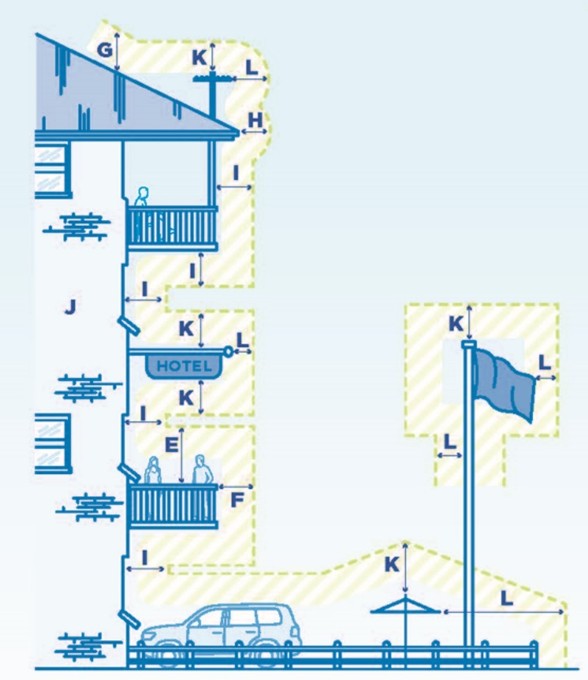
The clearances in the table and image below are vital to maintaining a safe distance from the powerlines, to staying out of the exclusion zone and minimising the risk of electric shock.
To ensure the right clearance, as well as identifying the voltage of any powerlines nearby, it is also important to know that powerlines can swing and sag.
Minimum powerline clearances from structures and buildings
Note: The letters in this table correspond to the codes in the graphic below. The vertical clearance OR the horizontal clearance must be maintained. The Regulations also include other clearance requirements for the overhead service lines that connect to the premises.
| Image code | Location | Direction | Low voltage Insulated1 powerline | Low voltage Bare2 powerline | High voltage ≤ 33kV powerline | High voltage ≤ 132kV powerline |
|---|---|---|---|---|---|---|
| E F |
Unroofed terraces, balconies, sundecks, paved areas etc. subject to pedestrian traffic only. A handrail or wall surrounding such an area and on which a person may stand. |
Vertically Horizontally |
2.7m 1.2m |
3.7m 1.5m |
4.6m 2.1m |
5.5m 4.6m |
| G H | Roofs or similar structures not used for traffic or resort but on which a person may stand. |
Vertically Horizontally |
2.7m 0.9m |
3.7m 1.5m |
3.7m 2.1m |
4.6m 4.6m |
| I | Covered places of traffic or resort such as windows which are capable of being opened, roofed open verandahs and covered balconies. | In any direction | 1.2m | 1.5m | 2.1m | 4.6m |
| J | Blank walls, windows which cannot be opened. | Horizontally | 0.6m | 1.5m | 1.5m | 3-4.6m |
| K L | Other structures not normally accessible to persons. |
Vertically Horizontally |
0.6m 0.3m |
2.7m 1.5m |
3.0m 1.5m |
3-4.6m 3-4.6m |
1- Insulated powerlines most often look like bundled black ‘liquorice like’ cables.
2 - Bare powerlines typically have multiple ‘silver’ aluminium conductors.
Breach of minimum clearances
Buildings or structures that don’t comply with the minimum clearances are a serious safety hazard. If your built structure is likely to come within the clearances, before the works starts, you have an obligation to notify us under the Regulations (penalties can apply). We’ll then provide advice.
We regularly inspect the electricity network, including aerial fly overs, to monitor for potential clearance breaches and other safety issues.
If a breach is identified after something is built, we contact the property owner to resolve the issue, or to pay for a change to the nearby electricity network to make it safe. This is often a significant cost.
From buildings to road signs
Some situations where minimum safety clearances should be considered include:
- A new build close to the electricity network, especially one that is on or near the property boundary
- Renovations, particularly where a small, single-story building is to become a much larger or a multi-story building
- Building carports, sheds, a greenhouse, or a cubbyhouse
- Positioning road signs or streetlights, or commercial signage and shop awnings, or billboards
- Installing a tall antenna, typically in areas where broadcast reception is poor
- Erecting a flag pole, shade sails or high fencing
- Erecting temporary fences or scaffolding, or placing shipping containers, close to poles or powerlines.
If you’re unsure if a planned building or structure will be too close to overhead or underground powerlines, get free Safety Advice.
During construction
Working near powerlines
Ensure workers, equipment and vehicles adhere to exclusion zones for the safety of everyone on the job site. These ‘no go’ areas represent the minimum safe distance that must be maintained by any person, vehicle or piece of equipment to reduce the risk of electric shock. Installation of powerline markers should be considered to highlight powerlines.
Excavating near poles and stay wires
You must meet the required distances when excavation or trenching work is performed near power poles and stay wire foundations to minimise the risk of compromising the structural integrity. Failure to do so may result in de-stabilising or damaging one or more poles causing a reduction in powerlines height or bring down overhead powerlines.
In addition, the ground level can’t be raised directly under powerlines if it means the legal clearances can’t be met.